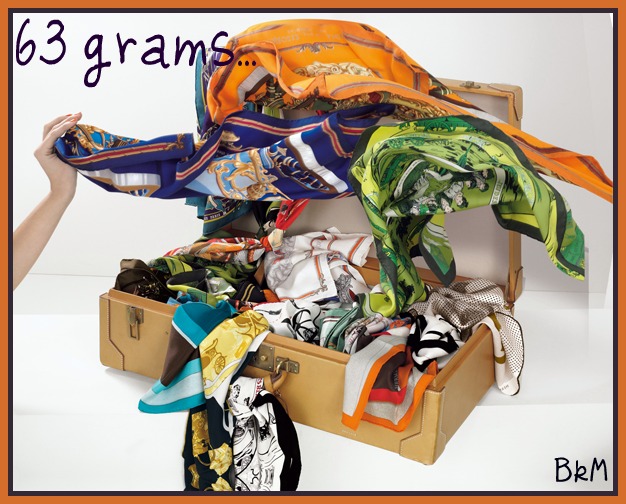
63 grams is the weight of an Hermès scarf

We do not grow absolutely, chronologically. We grow sometimes in one dimension, and not in another; unevenly. We grow partially. We are relative. We are mature in one realm, childish in another. The past, present, and future mingle and pull us backward, forward, or fix us in the present. We are made up of layers, cells, constellations.

Sunday, February 20, 2011

HUBERT DE WATRIGANT III Plaza de Toros 1993

PLAZA DE TOROS
First Issue: 1993
Catalogued: 3B


Not only is Hubert de Watrigant a brilliant equestrian painter but he is also a connoisseur of the world of tauromaquia, the art related to bulls and bullfighting as we can see in many of his paintings:


In Plaza de Toros he depicts the traditional elements of a classical Corrida de Toros. The scarf is designed around a broad circle which represents the bullring (La Plaza). In the very center we can see the entourage of authorities (alguaciles) who officially open the corrida, the montera (matador's hat)  two pairs of banderillas and a Matador jacket (la chaquetilla). 


This is the main piece of the Traje de Luces (Suit of Lights) called so for the reflections produced by the thousands of hand embroidered sequins and gold thread. A suit of lights can cost over 4000 Euros and some of the best known toreros wear it only once. Until the 18th century it was made of suede but since then is made of silk and adorned with gold for the matadors and silver for the banderilleros, the hat called montera, is made of astrakhan and lined in taffeta. This is a detail picture of the back of a chaquetilla:


Since the Traje de Luces is entirely hand made by accomplished artisans, it's not wonder that it inspired fashion designers like Galliano, Dior, Gaultier, Lacroix, etc:


Bullfighting and art have always walked hand in hand. The visual intensity of bullfighting has greatly fascinated plastic artist like Goya, Picasso, Dalí or Miró:


Several contemporary photographers have also gotten inspiration from bullfighting, like the French photographer Josephine Douet in her wonderful series on the handsome Spanish matador José María Manzanares:


Back to the silk, we can see other characters depicted on the scarf, like the Mozo de Mulas, Picador and Rejoneador (shown in the next pictures). Around the central motive, there are toreros performing different pases, meaning different figures of bullfighting art: Verónica, Pase de Pecho, Natural, etc. In the corners we can find four alamares, traditional decorations on a classic Traje de Luces.


Although it's the most popular, Plaza de Toros is not the only Hermès scarf inspired by bullfighting, Toros, by Hugo Grygkar is its predecessor from 1952, this scarf is a real rarity, I'll post more pictures of it in my future review on "The rarest Hermès scarves"


Although bullfighting is a sensitive issue for many people, it's also unquestionable that it has drawn the attention of several celebrities from the world of art, like Ernest Hemingway, Grace Kelly, Ava Gardner, Greta Garbo, Charlton Heston, Orson Welles, Mario Vargas Llosa, Mme and M. Sarkozy, etc.


Let's say hasta luego by now with a display of different color ways of this beautiful H. de Watrigant's design:


Friday, February 11, 2011

PHILIPPE LEDOUX III Haute Lice 1969

Dear vintage lovers, I have decided to discontinue the review on Hubert de Watrigant for the time being, the reason is that my dear friend Lily has made the most beautiful review on a vintage treasure, Haute Lice by Ledoux from 1969 and she has been kind and generous enough to allow me to post her wonderful work, read and enjoy!

Text and pictures credits: Lily (thank you so much, dear!)


*******************************


HAUTE LICE 1969
Philippe Ledoux
Catalogued: 3C

Another wonderful look into the past, compliments of Hermes and artist, Philippe Ledoux.


Haute Lice (pronounced ho-t-li-s) translates to high warp and applies to the process of weaving rather than to a tapestry itself.

In the haute lice manner, the warp is vertical, and the weaver stands behind it while weaving in the figures (or the woof). In the opposite method, basse lice (low warp), the warp is horizontal, and the weaver works in the pattern from above. In the haute lice method, he works from the wrong side of the tapestry (but in the basse lice, it is worked from the right side.) The work of the former method is slower, more difficult and, therefore, more expensive to produce and is considered of a “higher order.” 

These tapestries, which were used as elaborate wall and floor coverings, have their beginnings in the Middle Ages, and the most famous were known as the “Tapestries of Arras,” which were worked exclusively in the high warp method – haute lice - and often included the addition of gold or metallic threads.

From Les Tapis de Haute-Lice (Galerie Girard, Lyon, France, which still produces these tapestries today, worked on a high warp):

It was during the Crusades that Europeans discovered “hairy” carpets in the Near East. The Europeans endeavored to create their own versions and to compensate for economic losses sustained as a result of importations.


From the early 17th century, orientalizing styles are superseded by carpets from the Savonnerie Workshops (cotton is used for both the warp and the woof), and in the 18th century, by those of Aubusson and Beauvais (a combination of cotton used for the warp and wool and/or silk velvet for the woof). As status symbols and statements of good taste, these carpets were for the privileged kings and gentry, but they spread throughout Europe and the West: Spain in the Golden Age; Great Britain and its Moorfields, Exeter and Axminster carpets; America, Eastern Europe, Ireland, Scotland, Austria, the Netherlands and its Deventer workshops; Tournai in Belgium, etc. And in the last two centuries, designs by William Morris, Walter Grane, Charles Mackintosh, V. Horta, J. Olbrich, Frank Lloyd Wright, Sonia Delaunay, Picasso, Starck, Hockney and Harding.

Towards the end of the 20th century, the Aubusson workshops, the last great manufacturers, experienced ever greater difficulty producing and, even more so, selling the last Savonneries, as the cost of labor in the West had priced them out of the market. The last entrepreneurs “burned their boats,” setting up shop where labor was plentiful, qualified, inexpensive and skilled in the old ways.

Very few would succeed. Indeed, only those who already had the know-how in Aubusson technique and who settled in the very area where the most amazing textiles of the ancient world had been in production for quite some time with the enduring legacy of the masters of silk managed to succeed.”


And now – to the scarf.

In Ledoux’s little masterpiece, we see the artisan or licier at work on his high warp frame in the center of the scarf, and he closely resembles this drawing I found. He’s working from the wrong side of the tapestry, and you can see the various shuttles hanging from the weaving he’s completed, each of which used to weave a different color into the woof.


The center ground is a representation of the actual cotton warp – the basis and foundation for the weaving, and the four border panels represent various tapestries in production. I can’t identify them, but I would imagine that an historical tapestry expert could, as I’m sure that Ledoux probably used famous examples as his inspiration. Interestingly enough, Ledoux also incorporated the actual date of the design in Roman numerals in the center plaque - 1969.


Panel I at the bottom is an historical battle scene, perhaps? The figures seem to be running into battle with lances drawn.


The right panel represents a hunt scene, and a rather violent one at that. Hounds have chased an unfortunate stag into a river, and one is leaping at the stag’s throat, while another pack of hounds bays on the riverbank, and huntsmen blow their horns, encouraging the dogs on. Servants push off the bank in a dugout boat, probably to transport the bloody prize back to their lords, who eagerly await a feast of fresh venison.


The top panel is, fortunately, a much more pleasant - a peaceful scene of noblemen and their ladies enjoying a day in the country. One beautifully attired lady plays a harp, while her gentleman friend obligingly holds the music scroll for her, and another gallant offers his hand to a lady in an ermine-trimmed gown, attempting to cross a fast moving stream.


(It’s interesting to note that the costumes in this panel and the left panel appear to be Medieval or Renaissance era, while those in the bottom and right panels look to be more period 17th-18th century dress.)

The left panel is my favorite of the four. The work in progress seems to be Neoclassical in theme due to the Greek temple with Doric columns in the background. 


To the right, we see the proprietress of the workshop accepting payment for the work in progress (an installment plan, no doubt.) She already has a sizable pile of gold coins under her left hand, but she has managed to extract one more from the nobleman’s purse, which rests on her counter. From the look on his face, he seems to be a bit dismayed by the process, akin to a modern day DH paying at Hermes, no doubt!


I’m puzzled by the four figures in the various corners. At first, I thought they were probably famous artisans of the time, but the two in the lower bottom corners seem to be classical sculptures – a boy with a dog jumping at his side and in the opposite corner, a womanly figure, holding a crown in her hand, with a putto, or maybe just a child, at her side and a swan at her feet on the left. Perhaps she is an allegory for Mother France or possibly a reference to the famous Leda of Greek myth. 


However, I'm leaning towards the Leda myth. Notice the putti, particularly the one bearing the crown in the first painting below.)


The two female figures in the top corners appear to be in medieval costume. The one in the upper right is expecting, holding her hand over her pregnant stomach. Perhaps they are patrons or artisans themselves. Unfortunately, they remain a puzzle to me.


What doesn't puzzle me, however, is the beauty and artistry, as well as the historical detail of this scarf. Ledoux continues to amaze me! He is truly a stellar example of Hermes at its zenith.
Sunday, January 30, 2011

HUBERT DE WATRIGANT II. Le Carnaval de Venise 1993/Fetes Venitiennes 1999


January is practically over and Carnaval is coming!

Carnevale, also known as carnival or mardi gras, is celebrated in Italy and many places around the world 40 days before Easter, a final party before Ash Wednesday and Lent. Could it be a better time to review this scarf? 


LE CARNAVAL DE VENISE 1993 / FETES VENITIENNES 1999
Hubert de Watrigant
Jacquard silk
Catalogued: 4C/4D


Both scarves share the same design by Hubert de Watrigan on Jacquard Silk, the first of them, Le Carnaval de Venise is from 1993 while the second one, Fetes Venitiennes was issued in 1999. The Carnevale Comitee of Venice threatened to sue Hermès for the use of the name "Le Carnaval de Venise", forcing them to change the name of the scarf to "Fetes Venitiennes". 


This is one of the most colorful Hermes scarves and features a great number of color screens, its vibrant harmony makes it extremely attractive.


At the center, the design features a group of passerbyes dressed in period finery  admiring a lovely view of San Marco Basilica and Campanile, both in Piazza San Marco, around this beautiful settecento scene, there are groups of people dressed in carnaval costumes, typically inspired in La Commedia dell'Arte masks: Arlecchino, Bauta, Capitano, Brigella, Pulcinella... see La Comedie Italienne if you want to learn more about it.


The scarf is a masterpiece of geometry and use of color. It is divided in four main rhombus squares whose background color is repeated in the adjoining triangle to the left forming a stunning game of clever dynamism. Geometry is also present in the Venetian mooring poles and the gothic Venetian window at the center (Thank you dear Bonnie for your contribution):


Photo credit: Bonnie


The details of the characters are also amazing, the delicacy of the gestures and the clothes reminds me of the best vintages by Ledoux:


Le Carnaval de Venise and Fetes Venitiannes, has been produced in a wide array of colors always with contrast hems and beautiful combinations, thank you ScarfAddict for lending me your pictures:


I hope you have enjoyed this review. Next week, I intend to go on with Hubert de Watrigant part III featuring a special issue on Spanish themed scarves: Plaza de Toros, Feria de Sevilla and Real Escuela Andaluza del Arte Ecuestre, so we'll back to equestrian themes! Ci vediamo allora!


Wednesday, January 19, 2011

HUBERT de WATRIGANT I. Les Haras Nationaux 1989

HUBERT de WATRIGANT I. 
Les Haras Nationaux 1989


BIOGRAPHY:

Hubert de Watrigant was born in 1954 and brought up in South West France where his father bred and trained racehorses. He inherited natural artistic talent from his maternal great grandmother, a landscape artist in the nineteenth century, and his paternal great uncle.
The de Watrigant family had an inbred passion for horses and it was natural, therefore, that his artistic career should begin by sketching horses in his father's stables. At school he drew ceaselessly in the margins of his sketchbooks.
On leaving school he joined the Army to serve his year of National Service. He then moved to Paris and began to earn a living through various different jobs, although he continued to draw and paint in his spare time, enabling him to exhibit in various small shows. In 1976 de Watrigant decided to become a full-time professional artist, holding his first one-man exhibition at Maisons-Lafitte. In 1977 he entered Les Sept Collines de Rome exhibition. He won first prize.
De Watrigant uses a wide range of materials including charcoal, pastels, watercolour and oils and works on many different surfaces. His draughtsmanship is outstanding and he has a remarkable ability to capture both the ambience of his subjects and the drama of a fleeting moment.
Influences on de Watrigant's work include Delacroix, Géricault, and principally, René Princeteau, the first teacher of Toulouse-Lautrec, who de Watrigant admires for his fine draughtsmanship.
His career was helped at the start by his family contacts in the racing world, but the quality of his work was such that he soon became recognized as one of France's leading equestrian artists. As testament to his talent his work now features in numerous private and public collections in England, Japan and the Emirates. Private collectors include Her Majesty The Queen, as well as many of the leading connoisseurs of equestrian art, including Baron Guy de Rothschild, the late Stavros Niarchos and the late Daniel Wildenstein. In America he has been commissioned by a number of stud farms including Spendthrift Farm, Gainesway and Calumet.


WATRIGANT FOR HERMÈS:


Les Haras Nationaux 1989, photo credit: Pauillac


Hubert de Watrigant has worked for Hermès on a regular basis since 1989 and is one of its iconic illustrators, the chairman of the French company, Jean-Louis Dumas talked about his experience with the artist and his work this way:


“Some people lighten us. Their Talents open up your eye, carry you away, deprive you from with delicacy of your everyday inhibition mask and reduce your anesthesia. For several years, I have had the privilege to observe Hubert de Watrigant moving forward in the free but rocky way of artists and illustrators. Guided by instinct, he has trusted his stroke, has merged into his spontaneous watercolors. He based his work on Horses, Hunt dogs and especially on Bulls and on those who, in the bullfight, dance to death with them. 


Confronting his search for truthfulness in the harmony of life to the shock of emotions that bullfighting leads him to, he drew from his clever and graceful hand the strength to create series of amazing and engaging pictures. . The carrés that were born from his collaboration with our firm honor Hermes’ label and give it a supplement of elegance"


During so many years of collaboration, Watrigant has designed several scarves for La Maison, here you are a complete list of his works that I'll be presenting in the next weeks:

Les Haras Nationaux 1989
Carnaval de Venise (Fetes Venitiennes) 1993
Plaza de Toros 1993
Le Poitevin 1993
Real Escuela Andaluza del Arte Ecuestre 1996
Feria de Sevilla 1996
Ombrelles et Parapluies 1998
Musee Vivant du Cheval 2002
Un Siecle de Courses a Deauville 2003
Dans les Branches del’Ombu 2005
Lujo Criollo 2005
Croquis Champs de Courses 2007
Ballet Equestre 2007
Les Chevaux Quataries 2008
Les Poneys de Polo 2010


Hubert de Watrigant is basically an equestrian artist, his work has been exhibited in many galleries around the globe and his pictures are very coveted by equestrian art collectors:


As a horse painter, he has designed several of the most beautiful Hermès scarves based on equestrian theme. Les Haras Nationaux is the first profile I'd like to present, thank you very much to dear Pauillac who lend me her pictures:

LES HARAS NATIONAUX
Hubert de Watrigant
First Issue: 1989
Catalogued: 4C


If you want more information about Hubert de Watrigant, visit his web page:http://www.hubertdewatrigant.com/

You may also be interested in learn more about Les Haras Nationaux, this is its site:http://www.haras-nationaux.fr/

Next week, I am presenting a new profile: Carnaval de Venise (Fetes Venitiennes) 1993, by the same author, feel free to email me any pictures of this scarf you would like me to post.