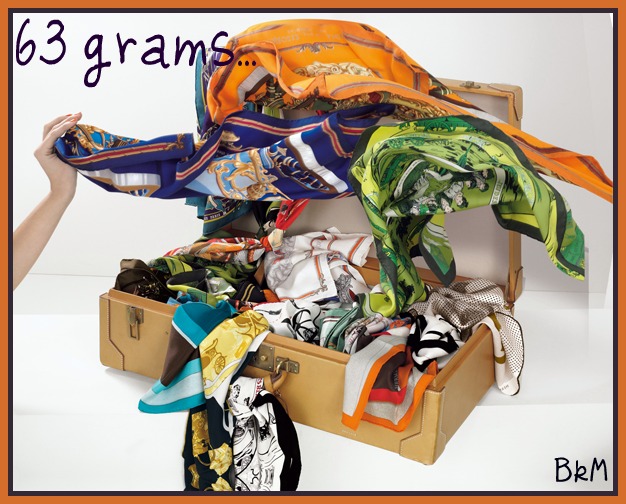
63 grams is the weight of an Hermès scarf

We do not grow absolutely, chronologically. We grow sometimes in one dimension, and not in another; unevenly. We grow partially. We are relative. We are mature in one realm, childish in another. The past, present, and future mingle and pull us backward, forward, or fix us in the present. We are made up of layers, cells, constellations.
Showing posts with label jacquard silk. Show all posts

Sunday, January 30, 2011

HUBERT DE WATRIGANT II. Le Carnaval de Venise 1993/Fetes Venitiennes 1999


January is practically over and Carnaval is coming!

Carnevale, also known as carnival or mardi gras, is celebrated in Italy and many places around the world 40 days before Easter, a final party before Ash Wednesday and Lent. Could it be a better time to review this scarf? 


LE CARNAVAL DE VENISE 1993 / FETES VENITIENNES 1999
Hubert de Watrigant
Jacquard silk
Catalogued: 4C/4D


Both scarves share the same design by Hubert de Watrigan on Jacquard Silk, the first of them, Le Carnaval de Venise is from 1993 while the second one, Fetes Venitiennes was issued in 1999. The Carnevale Comitee of Venice threatened to sue Hermès for the use of the name "Le Carnaval de Venise", forcing them to change the name of the scarf to "Fetes Venitiennes". 


This is one of the most colorful Hermes scarves and features a great number of color screens, its vibrant harmony makes it extremely attractive.


At the center, the design features a group of passerbyes dressed in period finery  admiring a lovely view of San Marco Basilica and Campanile, both in Piazza San Marco, around this beautiful settecento scene, there are groups of people dressed in carnaval costumes, typically inspired in La Commedia dell'Arte masks: Arlecchino, Bauta, Capitano, Brigella, Pulcinella... see La Comedie Italienne if you want to learn more about it.


The scarf is a masterpiece of geometry and use of color. It is divided in four main rhombus squares whose background color is repeated in the adjoining triangle to the left forming a stunning game of clever dynamism. Geometry is also present in the Venetian mooring poles and the gothic Venetian window at the center (Thank you dear Bonnie for your contribution):


Photo credit: Bonnie


The details of the characters are also amazing, the delicacy of the gestures and the clothes reminds me of the best vintages by Ledoux:


Le Carnaval de Venise and Fetes Venitiannes, has been produced in a wide array of colors always with contrast hems and beautiful combinations, thank you ScarfAddict for lending me your pictures:


I hope you have enjoyed this review. Next week, I intend to go on with Hubert de Watrigant part III featuring a special issue on Spanish themed scarves: Plaza de Toros, Feria de Sevilla and Real Escuela Andaluza del Arte Ecuestre, so we'll back to equestrian themes! Ci vediamo allora!


Wednesday, January 12, 2011

JACQUARD scarves


Joseph Marie Jacquard (1752-1834) revolutionised the weaving industry in France and is regarded by many as a forefather of the mechanical computer. The Jacquard Loom is a mechanical loom that simplifies the process of manufacturing textiles with complex patterns such as brocade, damask and matelasse. The loom is controlled by punchcards with punched holes, with each row of holes corresponding to one row of the design. Multiple rows of holes are punched on each card, and many cards that compose the design are strung together in a fan folded loop.
His invention was fiercely opposed by the silk weavers of the day who feared that its introduction, owing to the savings of labour, would deprive them of their livlihood. However its advantages secured its general adoption and by 1812 there were 11,000 Jacquard looms in use in France. The loom design was declared public property in 1806 and Jacquard was rewarded with a pension and royalty on each machine.


Hermès normally use standard silk twill for their 90cm. Just occasionally they would produce a batch of special designs using jacquard silk, gradually less frequently right up to the end of the 1990's. The jacquard used would usually have some association with the design of the scarf. Probably the best known is the "Bee" jacquard used on the Napoleon scarf.
Hermès scarves on jacquard silk are much valued by collectors and will always fetch a higher price than normal twill versions of the scarf. Some designs have been produced on several different jacquard designs, and all re-issues are now on normal twill silk. The jacquard is also a useful "watermark", virtually guaranteeing authenticity. It appears as a slightly raised, repeating pattern over which the scarf design is printed.
Below are some examples of the most commonly seen jacquards....

"Bees" - Napoleon 1995.................... "Firework" - Les Fetes du Roi Soleil 1994
 
"Kangaroo and Anchor" - Le Geographe 1992......."Holly Berry" - Neige d'Antan 2001.
 
"H Monogram" - La Cle des Champs - 1995.... "Lute and Mandolin" - Fetes Venitiennes 1999.
 
"Skaters" - Joies d'Hiver 1992............      "Galleon" - Christophe Colomb 1992.
 
"Star" - Cosmos 1964..........................  "Ginko Biloba" - Diamyo Princes du Soleil 1991.


Designs on jacquard silk include:

"Bees" - Napoleon 1963, Amours, Herbier de Gavarnie 1994.
"Chicken Wire" - Les Insectes 1959, Grand Vent 1965.
"Feather" - Races des Coqs
"Firework" - Feux d'Artifice 1987, Fetes du Roi Soleil 1994, Jouvence 1968
"Fish Scale" - Romantique, Fauconnerie Royale Deduit 1962.
"Galleon" - Christophe Colomb 1992.
"Ginko Biloba" - Diamyo 1991.
"H-Monogram" - La Cle des Champs, Louveterie Royale 1962, Romantique.
"Kites" - special edition of Amours
"Leopard Spots" - Kenya 1988.
"Lute and Mandolin" - Fetes Venitiennes 1999, La Comedie Italienne 1962.
"Peacocks" - Ciel Byzantine 1997.
"Prancing Horse" - l'Instruction du Roy 1993.
"Skaters" - Joies d'Hiver 1992.
"Stars" - Cosmos 1964, En Piste 1998, Emblemes de l'Europe 1993.
"Treble Key" - Orguaphone et Autre Mecaniques 1996.


The additional cost of producing jacquard silk today has so far preventing the fakers from attempting to copy it. Do remember that re-issues will be on plain silk twill but will still be genuine!  There are rumours that Hermès still have "one or two" rolls of jacquard silk hidden away for some very special limited issues.


Some of the data of this review are credit: Geoff Clarke

PHILIPPE LEDOUX I Napoleon 1963


NAPOLEON


Philippe Ledoux
Jacquard silk
First Issue: 1963
Reissues: 1985, 1995
Catalogued: 5D


This is my beautiful Napoleon by Philippe Ledoux:
(Este es mi precioso Napoleón por Philippe Ledoux:)


A detail of the central motive, the colors are incredible, antique green and burgundy, you could almost feel the touch of ancient velvet!!!


(Un detalle del motivo central, los colores son increíbles, verde antiguo y granate, casi puedes notar el tacto de viejo terciopelo:)


Philippe Ledoux made an extraordinary research when designing Napoleon, all four the corners are inspired on different paintings of the historical figure:

(Philippe Ledoux hizo una extraordinaria investigación cuando diseñó Napoleón, las cuatro esquinas están inspiradas en diferentes retratos de la figura histórica:)


Napoleon was wounded in Rattisbone:
(Napoleón herido en Ratisbona:)


This is the original painting by Pierre Gautherot:
(Esta es la pintura original de Pierre Gautherot)


The upper left corner is the most easy to recognize as it's based on a famous painting by JL.David depicting the Pass of St.Bernard:

(La esquina superior izquierda es la más fácil de reconocer porque está basada en una famosa pintura de JL David que muestra el Paso de San Bernard)


Original painting:

(Pintura original:)


The last corner (upper right) is the trickiest to recognize, it represents Napoleon proclaimed Premier Consul:


(La última esquina (superior derecha) es la más difícil de reconocer, representa a Napoleón proclamado Primer Consul:)


Ledoux got his inspiration from a tapestry, Tapisserie des Gobelins: 

Ledoux encontró su inspiración en un tapiz de Tapicería de los Gobelinos:


At the center of the scarf, Ledoux depicts the arrival at Notre Dame Dec 2, 1804 after burning the Book of Rites:


En el centro del pañuelo, Ledoux representa la llegada a Notre Dame el 2 de diciembre de 1804 después de quemar el Libro de los Ritos:


Symbols and arms in Napoleon:


The Bees: the golden bees called cicadas, are symbol of immortality and resurrection, they were chosen to link the new dynasty to the very origins of France as cicadas were discovered in the tomb of Childeric I, founder of Merovingian dynasty in 457. Bees are the oldest symbol for French monarchy.

The uniforms in the center, the swords: on the left there is the First Consul dresscoat, on the right, Napoleon's Chasseurs à Cheval uniform. Further down the design, the First Consul and Coronation swords can be seen, as well as two sabres from the Egyptian campaign.

The chain of the Légion d'honneur: it took its name from ancient Rome. The chain of the Légion d'honneur, reserved for the emperor, princes of the imperial family and grand dignitaries, is composed of a gold chain made of 16 trophies linked by eagles with the ribbon and cross of the order at their necks. This chain is bordered on either side by a small chain alternating stars and bees. The central motif, the Napoleonic N, is encircled by a laurel wreath and supports the cross of the Légion d'honneur, a five-pointed pommel-pointed star, in white enamel. In the centre is the laurel-crowned profile of the emperor, the whole surmounted by the imperial crown.

The Eagle: it's a symbol of imperial Rome, Jupiter's bird, and was associated from the earliest antiquity with military victory. The day after his coronation, Napoleon had an eagle placed at the top of the shaft of every flag in the Napoleonic army.


I've tried to discover the real meaning of the number 25 displayed four times on the scarf. I should think that it has something to do with freemasonry, 25 is a powerful number for old freemasons and it's possible that Ledoux belonged to some of this societies in France as Napoleon did.


Napoleon is a jacquard silk scarf, for more information about jacquard technique in Hermès scarves, please visit the following link:
Napoleón es un pañuelo en jacquard de seda, para más información sobre está técnica en Hermès, por favor, visita el siguiente link:


Original paint
Napoleón